
Views: 0 Author: Site Editor Publish Time: 2026-09-08 Origin: Site


Advanced composites are rapidly replacing traditional heavy materials across multiple industrial sectors. Commercial buildings, transportation networks, and modern manufacturing facilities now face strict efficiency mandates. Weight reduction is no longer an optional upgrade. It represents a strict operational requirement. Engineers and procurement teams face a familiar dilemma during the specification phase. They must evaluate whether to stick to legacy aluminum honeycomb structures or transition to advanced composite alternatives.
Making the wrong choice leads to heavy installations or premature partition failure. This article provides a comprehensive, evidence-based breakdown of these two materials. We examine core mechanical properties, daily fabrication realities, and long-term durability. We also explore environmental resilience and specific use cases. By understanding these material physics, you will make a highly confident material specification. You will learn exactly how each panel behaves under real-world physical stress.
Weight vs. Impact: A CFRT honeycomb panel offers superior impact resistance and rebound memory compared to aluminum, which is prone to permanent denting.
Corrosion & Moisture: CFRT eliminates the galvanic corrosion and moisture degradation risks inherent in metal panels.
Fabrication: Aluminum requires specific metal-cutting tools; CFRT allows for easier on-site sizing and flexible edge-banding.
Cost Dynamics: While upfront material costs may be similar, CFRT often lowers TCO through reduced shipping weight, faster installation, and lower lifetime maintenance.
Selecting the right partition material requires a rigorous evaluation of multiple engineering variables. Modern structural designs demand materials capable of surviving harsh environments while remaining exceptionally light. We evaluate partition materials based on strict success criteria.
Engineers typically rank panel materials against four critical benchmarks:
Strength-to-Weight Ratio: The panel must support dynamic loads without adding unnecessary mass.
Long-Term Durability: The material needs to resist physical impacts, chemical exposure, and moisture ingress over its lifespan.
Aesthetic Compatibility: The surface must accept various finishes, laminates, and veneers cleanly.
Regulatory Compliance: The structure must pass industry-specific fire, toxicity, and structural standards.
Global industries face immense pressure to reduce carbon footprints and improve operational efficiency. Modern projects require a highly engineered Lightweight Composite Partition Board to minimize structural loads in buildings. In the transportation sector, cutting weight directly translates to lower fuel consumption. Marine vessels, recreational vehicles (RVs), and commercial aircraft rely on ultralight partitions to maximize payload capacity. Every kilogram saved improves overall system efficiency.
Solid partition panels transfer sound and mechanical vibrations easily. Honeycomb structures inherently dampen noise. The hexagonal cell geometry traps acoustic waves inside empty pockets. As sound waves pass through the core layers, they lose kinetic energy. This phenomenon makes honeycomb panels ideal for engine enclosures, cabin partitions, and noisy industrial zones. Both aluminum and composite cores excel at acoustic damping, but their distinct material densities create different frequency-blocking profiles.
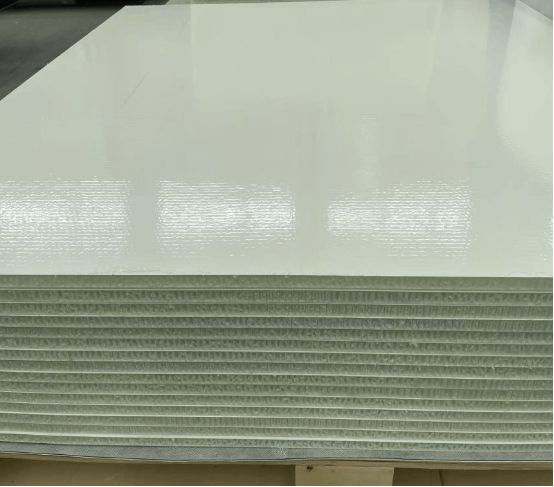
Understanding how these two materials react to physical stress requires looking closely at their chemical structures. They utilize the same geometric core shape, but their molecular behaviors differ drastically.
Aluminum panels feature aluminum alloy skins structurally bonded to an aluminum hexagonal core. They deliver exceptionally high stiffness and rigidity. However, aluminum possesses a rigid yield point. Once physical stress exceeds this limit, the metal bends permanently.
Conversely, a CFRT honeycomb panel utilizes continuous woven fiberglass impregnated with a thermoplastic resin. Manufacturers bond these durable skins to a resilient thermoplastic core. This combination yields high toughness and a highly flexible yield point. The composite matrix bends under extreme force rather than snapping or crushing.
Impact resistance highlights the most significant divergence between these two technologies. Aluminum absorbs kinetic energy through plastic deformation. If a heavy cart strikes an aluminum partition, the metal dents. The panel suffers permanent aesthetic and structural damage. You cannot easily pop the dent back out.
CFRT absorbs sudden shock through elastic deformation. The continuous glass fibers distribute the impact load across a wide surface area. The thermoplastic matrix acts like a heavy-duty spring. It absorbs the blow and quickly rebounds to its original shape. This "memory" effect prevents permanent damage in high-traffic corridors and cargo holds.
Both materials consistently achieve a Flat Surface Honeycomb Panel profile. This flatness provides an excellent canvas for interior design. However, bare aluminum struggles to hold commercial adhesives. You must aggressively prime and chemically treat metal surfaces before applying decorative laminates. If you skip these steps, veneers will peel over time.
CFRT provides a superior bonding substrate. The thermoplastic skin reacts beautifully to standard commercial adhesives. You can easily laminate PVC films, wood veneers, or decorative fabrics directly onto the composite face. The resin-rich surface ensures a permanent, bubble-free bond.
Theoretical strength matters, but practical fabrication dictates daily project workflows. Installers face distinct challenges when modifying these panels on active job sites.
Modifying aluminum requires specialized metal-cutting tools. Saw blades must feature specific carbide tooth profiles to prevent tearing the fragile metal core. Cutting aluminum generates sharp metallic burrs and hazardous sparks. Installers must carefully deburr every cut edge before assembly to prevent injuries.
CFRT machines like dense hardwood. Installers easily cut these panels using standard woodworking tools or basic composite routers. The thermoplastic matrix cuts cleanly. The process produces zero sparks and leaves no dangerous metallic burrs behind. This dramatically speeds up on-site modifications and improves worker safety.
Unsealed honeycomb cores trap dust, moisture, and bacteria. Creating a properly Edge-sealed Honeycomb Panel requires deliberate engineering.
Aluminum cores present significant edge-sealing challenges. You cannot melt aluminum on-site to seal the edge. Installers must rely on heavy aluminum U-channels, messy epoxy potting compounds, or complex metal-folding techniques. These methods add unnecessary weight and require intense manual labor.
CFRT simplifies this process entirely. Because the entire panel consists of thermoplastics, you can manipulate it using heat. Installers utilize seamless thermal edge-welding to pinch and fuse the skins together. Alternatively, they apply simple thermoplastic edge-banding using standard hot-melt equipment. These thermal techniques completely prevent moisture ingress.
Joining panels requires strong structural connections. Aluminum assemblies rely heavily on mechanical fasteners, rivets, or structural adhesives. Mechanical fasteners create localized stress points, which can cause metal fatigue over time.
CFRT allows for advanced thermal joining. Installers can weld composite panels together using ultrasonic welders or hot gas tools. Heat fuses the thermoplastic molecules into a single continuous piece. Welded joints eliminate the need for heavy metal brackets and distribute structural stress evenly.
Partitions often endure severe environmental conditions. Temperature swings, chemical spills, and moisture exposure constantly threaten structural integrity.
CFRT possesses an inherently waterproof nature. Thermoplastics do not absorb water, rot, or degrade in humid environments. They remain chemically inert against most industrial cleaners and moderate acids. You can safely install composite panels in washdown zones.
Aluminum naturally resists rust, but it suffers from galvanic corrosion. If moisture touches the aluminum panel while it rests against a dissimilar metal like steel, an electrical reaction occurs. The aluminum rapidly oxidizes and breaks down. This makes bare aluminum risky for damp marine environments.
Engineers carefully monitor the Coefficient of Thermal Expansion (CTE). This metric measures how much a material stretches or shrinks during temperature swings. Aluminum expands and contracts noticeably when exposed to intense heat or freezing cold. If installed rigidly, metal panels will buckle or warp.
CFRT maintains much higher dimensional stability. The continuous glass fibers lock the thermoplastic matrix in place. The panels resist shrinking and swelling across varied climates. This stability keeps decorative seams tight and prevents structural warping.
Fire regulations dictate material selection in commercial buildings and public transit. Aluminum naturally achieves an A-class non-combustible rating. Solid metal does not burn or contribute fuel to a fire. It serves as an excellent heat shield.
Standard CFRT consists of combustible polymers. Out of the box, standard composites do not meet strict fire codes. However, manufacturers blend specific flame-retardant (FR) additives into the resin matrix during production. These engineered FR panels successfully pass stringent ASTM and EN fire standards. You must always verify building code requirements before specifying composite panels for escape routes.
Material Physical Trait Comparison
| Physical Trait | Aluminum Honeycomb | CFRT Honeycomb |
|---|---|---|
| Impact Rebound | Poor (Permanent Denting) | Excellent (Elastic Memory) |
| Moisture Resistance | Good (Risk of Galvanic Corrosion) | Exceptional (100% Waterproof) |
| Machinability | Complex (Sparks, Burrs) | Simple (Standard Tools) |
| Edge Sealing Method | U-Channels, Epoxy Potting | Thermal Welding, Edge Banding |
| Inherent Fire Rating | Class A (Non-Combustible) | Requires FR Additives |
Material procurement involves far more than simply selecting a panel type. Logistical friction and long-term maintenance drastically alter a project's overall trajectory. Smart specification requires analyzing the entire material lifecycle.
Weight directly dictates freight efficiency. Heavier panels restrict how much square footage you can load onto a single commercial truck. By leveraging lighter composite structures, procurement teams maximize trailer volumes. You move more partition boards per shipment, significantly streamlining supply chain logistics.
Site handling also improves dramatically. Heavy aluminum assemblies often require specialized lifting equipment or multiple workers just to maneuver a single partition. Lighter composite boards allow smaller crews to position and secure panels manually. Faster handling translates directly to accelerated construction timelines.
Maintenance teams constantly battle physical wear and tear in high-traffic environments. Public restrooms, marine interiors, and RV cabins experience daily abuse. When carts, luggage, or equipment strike aluminum partitions, the metal dents permanently. Replacing a dented panel requires tearing down the framing, ordering custom sizes, and re-installing new hardware.
CFRT completely shifts this maintenance paradigm. The material's impact memory absorbs severe blows without holding a permanent crease. Scratches on the thermoplastic surface can often be polished or gently heated to smooth out imperfections. Facilities teams spend far less time replacing broken panels. They can redirect their maintenance efforts toward more critical building operations. The durability of composites ensures the partition remains visually appealing for years.
Choosing between these two advanced materials requires aligning the physics of the panel with your specific environmental demands. Neither material is universally superior. You must weigh the structural trade-offs.
You should specify aluminum honeycomb when your project involves extreme temperature thresholds. Choose metal if building codes mandate absolute non-combustibility without the use of chemical additives. Aluminum also excels in legacy projects where you must integrate new panels into existing metal-to-metal structural framing. It remains the gold standard for high-heat shielding applications.
You should transition to CFRT if your primary priority is maximizing impact resistance. Choose composites when you need to achieve the lowest possible total weight for transportation efficiency. CFRT dominates in highly corrosive, wet, or marine environments where metal panels inevitably fail. Finally, specify composites if you want to drastically simplify on-site fabrication and streamline thermal edge-sealing processes.
The choice between CFRT and aluminum is rarely about selecting a "better or worse" product. Success depends entirely on aligning material physics with specific environmental stresses and fabrication realities. Aluminum offers incredible stiffness and innate fire resistance. CFRT delivers unmatched impact memory, seamless thermal welding, and total immunity to moisture.
By defining your project requirements clearly, you eliminate specification guesswork. Review your structural loads, aesthetic goals, and long-term maintenance expectations. Next, take concrete action to validate your choice. Request technical data sheets for both materials. Order a physical sample pack to perform your own drop and impact testing. Consult with composite engineering teams to review your exact partition blueprints.
A: Exact weights vary based on skin thickness and core density. However, a typical 15mm CFRT panel generally weighs between 3.5 to 4.5 kg/m². A comparable 15mm aluminum panel usually weighs between 5.0 to 6.5 kg/m². Composites typically offer a 15% to 30% weight reduction over standard aluminum builds.
A: Yes. Both materials accept decorative laminates and veneers. However, CFRT’s thermoplastic surface bonds much stronger with standard commercial adhesives. Bare aluminum requires aggressive sanding, special primers, or specific epoxy-based glues to prevent the veneer from delaminating over time.
A: Because CFRT consists entirely of thermoplastics, you can seal the edges using heat. Manufacturers use thermal pressing or ultrasonic welding to melt and fuse the top and bottom skins together over the core. This eliminates the need for heavy secondary metal framing or messy epoxy fillers.
A: CFRT panels serve perfectly as semi-structural or non-load-bearing interior partitions. They support their own weight and handle heavy surface impacts effortlessly. However, for primary heavy structural loads holding up roofs or upper decks, you still require traditional steel, heavy timber, or reinforced concrete framing.