
Views: 0 Author: Site Editor Publish Time: 2026-09-23 Origin: Site


The commercial transport, RV, and modular construction industries are changing fast. They now rely heavily on lightweight, high-strength composite structures. Engineers constantly struggle during the material specification process. They must balance strict weight limits against rigid thermal requirements. Highly fluctuating manufacturing costs make this process even harder. Finding the perfect equilibrium is difficult. Heavy traditional materials drastically drag down payload capacity. Weak insulation ruins cold chain logistics and increases energy use. You need a clear path forward. We will provide an objective breakdown in this guide. You will see how different core materials impact structural integrity. We will explore production viability and long-term performance. You will learn to evaluate specific core properties. This helps you select the optimal setup for your application. You can achieve high performance metrics without overspending on raw materials.
Core material selection accounts for 40-60% of total CFRT panel manufacturing costs, dictating both thermal efficiency and structural shear strength.
A Polyurethane Insulation Core offers the best baseline thermal efficiency, while a Recycled PET Foam Core excels in mechanical strength and sustainability compliance.
Continuous lamination methods reduce per-unit production costs by up to 30% compared to batch processing, though they require higher initial volume commitments.
Evaluating Total Cost of Ownership (TCO) requires factoring in long-term durability, moisture resistance, and tooling amortization, not just raw material price.
Engineers establish baseline requirements early in the design phase. They must clearly define structural load capacities. Thermal conductivity often dictates material viability. We measure this using R-values or k-values. Weight tolerances also play a massive role in final material selection. You must map these demands accurately before choosing a core.
We look at cost-to-performance ratios instead of simple per-square-meter pricing. This reveals true strength-to-weight financial benefits. Consider logistics and freight companies. A lighter composite panel directly translates to payload gains. They can carry more cargo per trip. The upfront material premium quickly pays for itself through increased revenue.
Compliance and lifespan metrics serve as mandatory evaluation lenses. Environmental regulations push manufacturers toward greener alternatives. Fire retardancy (FR) ratings remain strictly enforced in commercial spaces. We also factor in end-of-life recyclability. Selecting materials compliant with future sustainability mandates protects your investment. You avoid costly redesigns when regulations inevitably tighten.
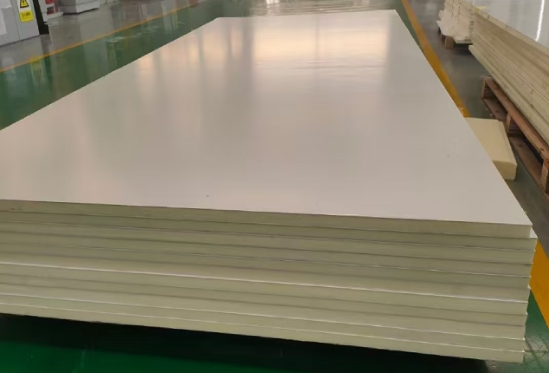
Selecting the right core defines the success of your CFRT foam panel. Each material presents unique advantages and distinct limitations. We match technical specifications directly to real-world application needs.
This material delivers exceptional thermal insulation properties. A Polyurethane Insulation Core forms strong chemical bonds with thermoplastic skins during manufacturing. The rigid cell structure traps gasses effectively. This creates a superior thermal barrier.
The raw material cost remains relatively moderate. PU scales incredibly well in continuous production lines. This scalability keeps large-volume production costs low. You gain reliable performance without breaking the budget.
We recommend PU for refrigerated transport and cold chain logistics. It also dominates temperature-controlled modular buildings. Anywhere thermal retention is the priority, PU performs best.
PET foam features remarkably high shear strength. It offers excellent fatigue resistance over millions of stress cycles. A Recycled PET Foam Core easily handles high temperature tolerance during processing. This allows for rapid thermo-compression cycle times.
You will face a higher upfront material cost. However, its immense strength offsets the need for secondary structural reinforcements. You eliminate heavy metal inserts. It also aligns perfectly with strict green-procurement mandates.
This core excels in high-stress structural floors. Aerospace applications utilize it heavily. Impact-prone transit walls also benefit from its toughness. Choose PET when load-bearing capacity matters most.
XPS provides superior moisture resistance in demanding environments. It boasts near-zero water absorption. An XPS Closed-cell Foam Core delivers consistent structural stability over time. It refuses to degrade when exposed to damp conditions.
This material is highly cost-effective for large-volume runs. It works best in non-load-bearing applications. The closed-cell surface lowers resin uptake during lamination. This directly saves you money on expensive adhesive costs.
We see XPS used extensively in RV sidewalls. Marine bulkheads rely on its waterproof nature. Wet-environment modular construction also favors this core. Use it whenever moisture intrusion poses a threat.
Core Material Performance Comparison
| Core Type | Thermal Insulation | Shear Strength | Moisture Resistance | Cost Profile |
|---|---|---|---|---|
| Polyurethane (PU) | Excellent | Moderate | Good | Moderate |
| Recycled PET | Good | Excellent | Good | High Upfront |
| XPS Closed-cell | Good | Low | Excellent | Highly Cost-Effective |
Understanding production expenses requires looking past the raw core price. The skin-to-core economics dictate major financial outcomes. The thickness of continuous fiber reinforced thermoplastic skins matters. Skin orientation changes the required density of the chosen foam core. Thinner skins demand higher density foams to prevent buckling. You must balance skin cost against core density costs.
Adhesives and bonding methods introduce significant cost differences. Thermal fusion utilizes the existing thermoplastic matrix. It melts the skin directly into the core. This eliminates secondary glue costs entirely. Alternatively, polyurethane-based adhesives require additional raw materials. They add weight and increase labor time. Thermal fusion generally provides better long-term value.
Process efficiency drastically alters your final budget. We evaluate continuous versus batch processing carefully.
Continuous Line Lamination: This method requires high setup costs. However, it demands very low labor. You experience minimal material scrap. It remains optimal for standard thicknesses and high-volume orders.
Vacuum Infusion / Press Lamination: This batch process features lower tooling costs. It requires higher manual labor. Cycle times are notably slower. It works much better for custom, low-volume runs and complex shapes.
Energy and tooling amortization must remain transparent. Mold costs quickly add up for custom geometries. Press heating energy fluctuates based on local utility rates. Regular machine maintenance prevents expensive downtime. You must factor these hidden variables into your financial projections.
Lab specifications do not always translate perfectly to the factory floor. Delamination vulnerabilities pose a major threat. You must address the risk of skin-to-core separation. This happens under severe thermal cycling. It occurs if the coefficients of thermal expansion (CTE) are mismatched. For example, a dark-colored RV panel bakes in the desert sun. The skin expands faster than the core. This shears the adhesive layer. You must match CTE values closely to prevent failures.
Machinability and scrap rates impact your production speed. Real-world considerations arise when routing and cutting. Inserting hardpoints into varying foam cores requires precision. PU cores cut cleanly but create fine dust. PET cores require tougher tooling due to their dense structure. XPS melts if cutting speeds generate too much friction. You need optimized CNC parameters for each specific core.
Lead times and material availability disrupt global operations. You must navigate complex supply chain constraints. Specialized thermoplastic resins face periodic shortages. Recycled PET feedstock availability fluctuates based on consumer recycling rates. We recommend qualifying secondary suppliers early. Keep buffer stock for highly specialized core densities. This protects your production line from unexpected halts.
Moving from technical research to actual procurement requires a systematic approach. Do not guess. Follow a structured framework to guarantee success.
Step 1: Metric Alignment. Map core material limits directly against your absolute non-negotiables. Define your breaking points. If moisture resistance is critical, prioritize XPS immediately. If structural load limits define the project, shift to PET. Eliminate materials that fail your primary test.
Step 2: Volume vs. Tooling Analysis. Calculate your exact break-even point. Compare custom panel thicknesses against off-the-shelf continuous run panels. A custom thickness might save weight. However, the custom tooling cost might negate those savings. Find the financial intersection.
Step 3: Prototyping Requirements. Never commit to full-scale production blindly. Require physical mechanical testing first. Demand 4-point bending tests. Verify peel strength limits in a lab. Real-world physical validation prevents disastrous mass-production errors.
The single "best" composite panel simply does not exist in a vacuum. It is strictly defined by specific operational parameters. You must weigh the intersection of the operating environment, load requirements, and production volume. Each core material serves a distinct engineering purpose. PU dominates thermal management. PET handles extreme structural loads. XPS provides unbeatable moisture protection on a budget.
We advise you to avoid over-engineering your panels. Paying for excess structural strength ruins profit margins. Specify a core that meets exact thermal and structural baselines. Do not exceed them unnecessarily. Leverage continuous manufacturing lines whenever your order volumes permit. This drives down unit costs aggressively. Follow the prototyping framework, validate your metrics, and build with confidence.
A: PET foam generally carries a 15-25% premium upfront over standard PU. However, it offers superior structural shear strength. This added strength can eliminate the need for internal metal reinforcements. By removing these heavy metal inserts, you potentially lower your overall assembly costs and reduce final product weight.
A: While XPS offers excellent moisture resistance, it has lower shear strength than PET. It is highly ideal for non-load-bearing sidewalls. However, it typically requires additional internal reinforcement if used in heavy load-bearing floor applications within commercial transport.
A: Delamination usually results from improper adhesive application during manufacturing. It also happens from insufficient pressing temperature during thermal bonding. Furthermore, using a core material with a significantly different thermal expansion rate (CTE) than the outer skin will shear the bond during temperature changes.
A: Yes, the thermoplastic skins are highly recyclable. When paired with a recycled PET foam core, the entire panel can theoretically be shredded, re-melted, and repurposed. This offers a massive environmental advantage over traditional thermoset fiberglass panels, which often end up in landfills.